
 Plan
PlanLumens, lux, and watts are three different questions
Brightness, light on a surface, and energy use belong in separate columns. Once they are separated, a lighting plan becomes much easier to read.
Field notes · No. 01
Clear explanations for the parts of residential light that a product box or one-number rule leaves out.
PlanBrightness, light on a surface, and energy use belong in separate columns. Once they are separated, a lighting plan becomes much easier to read.
 Shape
ShapeA beam-angle number becomes useful only when it meets a mounting distance, a surface, and the fixture’s real photometric distribution.
 Feel
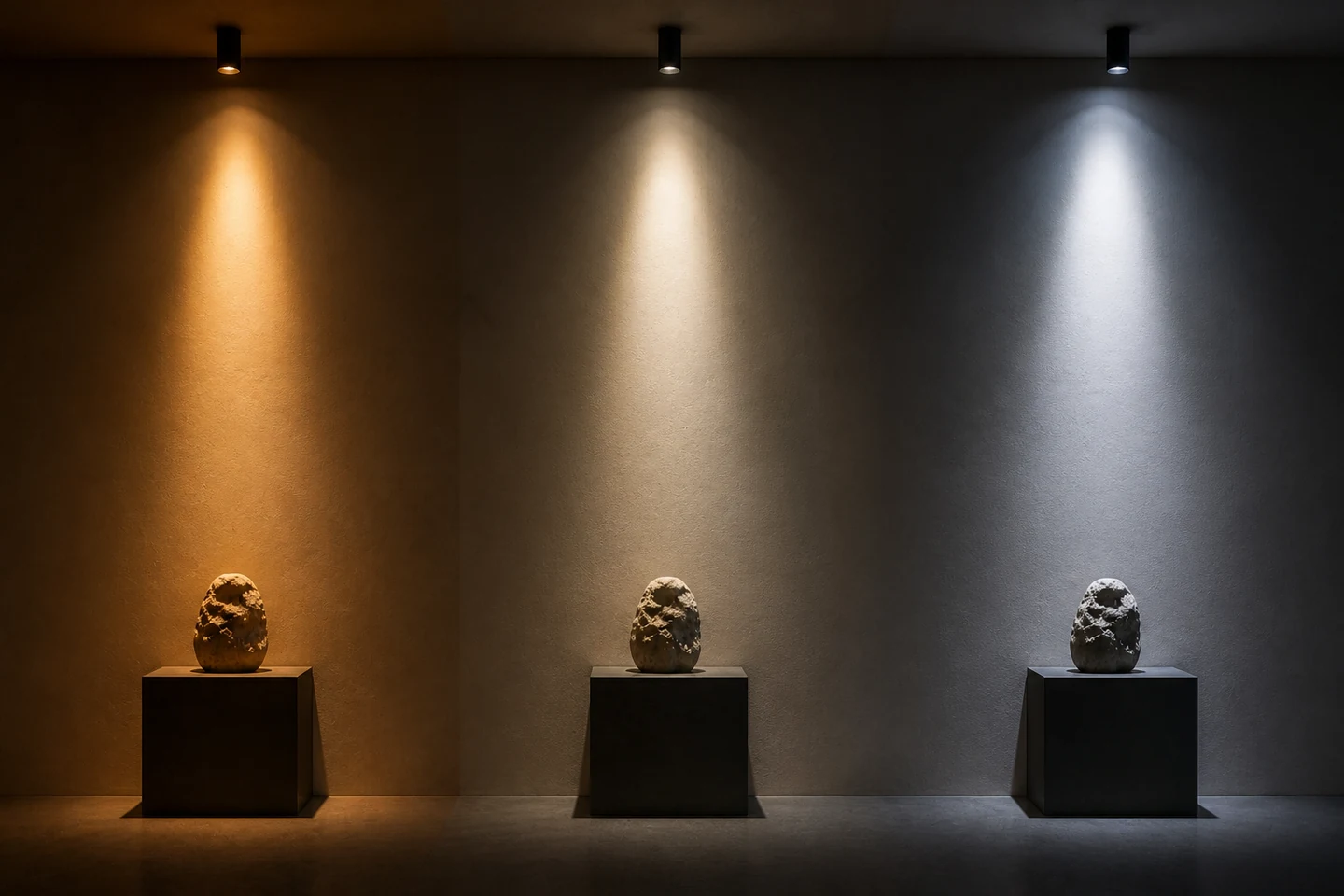
FeelKelvin is a compact description of white-light appearance—not a complete prediction of how a room, material, or person will look.
ChooseCRI remains familiar, but newer fidelity metrics reveal why one score cannot describe every color under an LED.
PlanAmbient, task, and accent layers work best when each solves a distinct visual job instead of every fixture trying to light everything.
 Plan
PlanRules of thumb are only starting marks. The real test is the relationship among ceiling, surface, fixture, glare, and the people using the room.
PlanAn even ceiling grid is easy to draw. A useful layout begins with walls, work planes, beams, furniture, and the photometry of the fixture.
ChooseThe label is a compact comparison tool. It becomes powerful when brightness, energy, color, life, and compatibility are evaluated separately.