Color Rendering Index has been the familiar shorthand on lamp specifications for decades. It is still useful, especially for quick minimum screening, but it compresses a complex spectrum into a score that cannot explain every hue or preference.
What CRI can and cannot say
General CRI, often written Ra, averages a limited set of test colors under the source compared with a reference of similar color temperature. A value of 80 or 90 can support a practical first comparison. It does not guarantee that saturated red, skin, artwork, or food will look the way you expect.
The U.S. Department of Energy notes that 80 is a common minimum for interior lighting and 90 or higher indicates excellent color fidelity in the CRI framework. That remains a framework-specific statement, not proof that all products with the same number share the same spectrum.
Why Rf adds information
Newer systems such as IES TM-30 use a much larger color evaluation set and report fidelity as Rf alongside additional information about gamut and hue shifts. CIE’s 2025 position statement recommends gradually replacing the old general color rendering index with Rf while reporting both during a transition period.
That recommendation does not make CRI labels useless overnight. It does mean that a careful product comparison should look beyond one headline number when manufacturers publish fuller color data.
Make a small material test
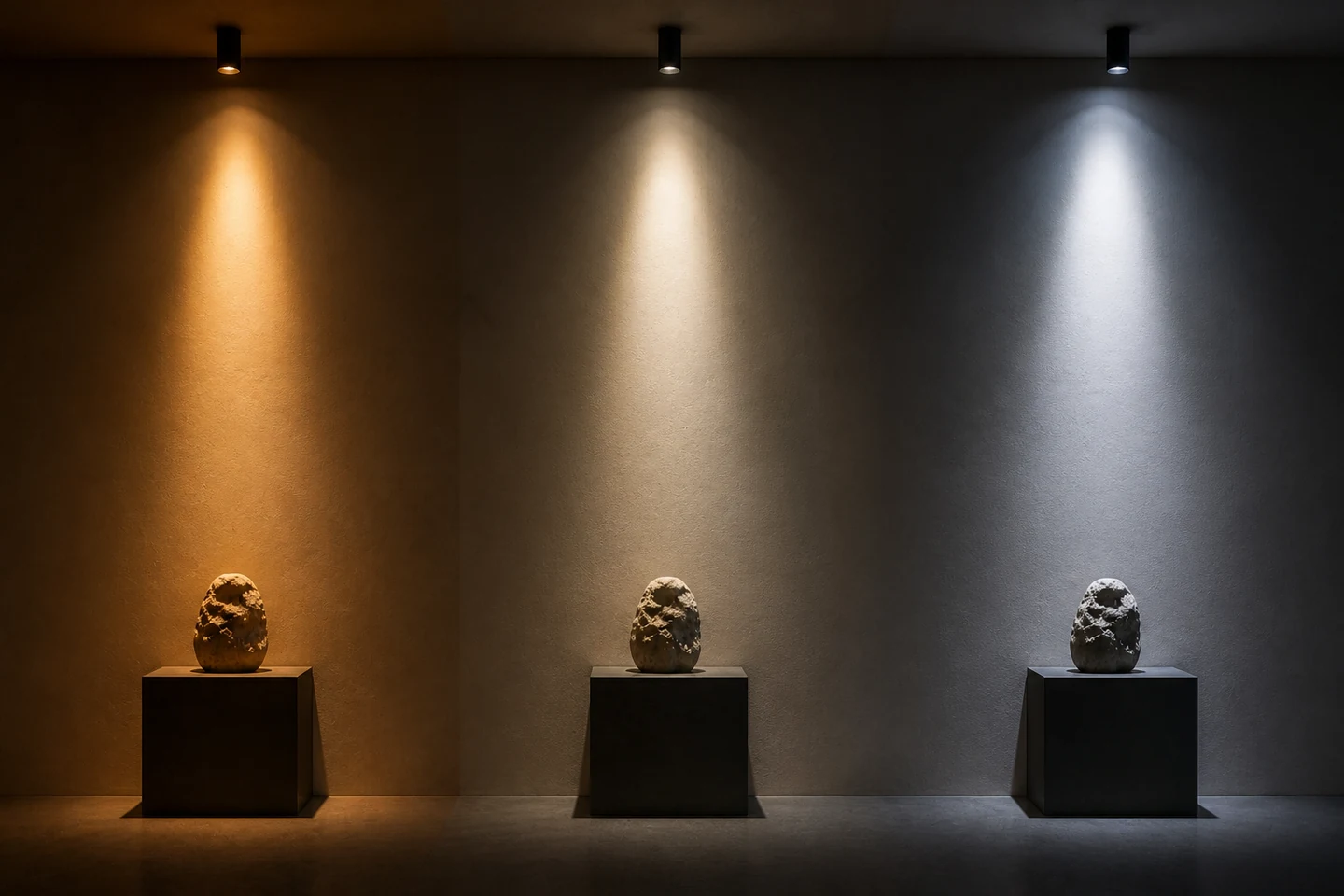
Specifications narrow the field; samples resolve the room. Place competing lamps in the real fixture or a comparable temporary socket. Look at faces, red and blue objects, wood, paint, artwork, food, and neutral whites at the times you use the space.
Keep color temperature similar when comparing color fidelity. A cooler or warmer source can dominate perception and make it hard to isolate differences caused by spectral quality.
A score is a map. A material mock-up in the actual room is the journey.
Use CRI as a familiar screen, seek Rf or fuller spectral information when available, and verify important materials with a real sample.
Source desk
References
- U.S. Department of EnergyLED Basics↗
- International Commission on Illumination (CIE)CIE Position Statement on Colour Quality Metrics, 2nd Edition↗
Sources support the stated concepts; Glow & Gauge’s simplified planning tools are independent adaptations and not endorsed by these publishers.