
Lighting Facts moved household lamp comparison away from wattage as a stand-in for brightness. The label gives several useful values, but no single row proves that a product belongs in your room.
Start with lumens, then examine watts
Lumens describe total output. Once two candidates deliver the amount of light you need, watts help compare power demand. Lumens divided by watts gives efficacy, but the most efficient option can still be wrong if its distribution, color, glare, or controls do not fit the application.
Ignore marketing names such as ‘60-watt replacement’ until you read the actual lumen value. Replacement language is approximate; the fixture and shade can reduce delivered light further.
Use your own cost assumptions
Package cost estimates depend on a stated number of hours and electricity rate. Your schedule and local price may differ. The Glow & Gauge cost tool keeps both visible so you can reproduce the estimate.
For products with controls, standby power and dimmed operation can change real use. Treat the simple annual cost as a comparable baseline, not a utility-bill forecast.
Read appearance and fidelity together
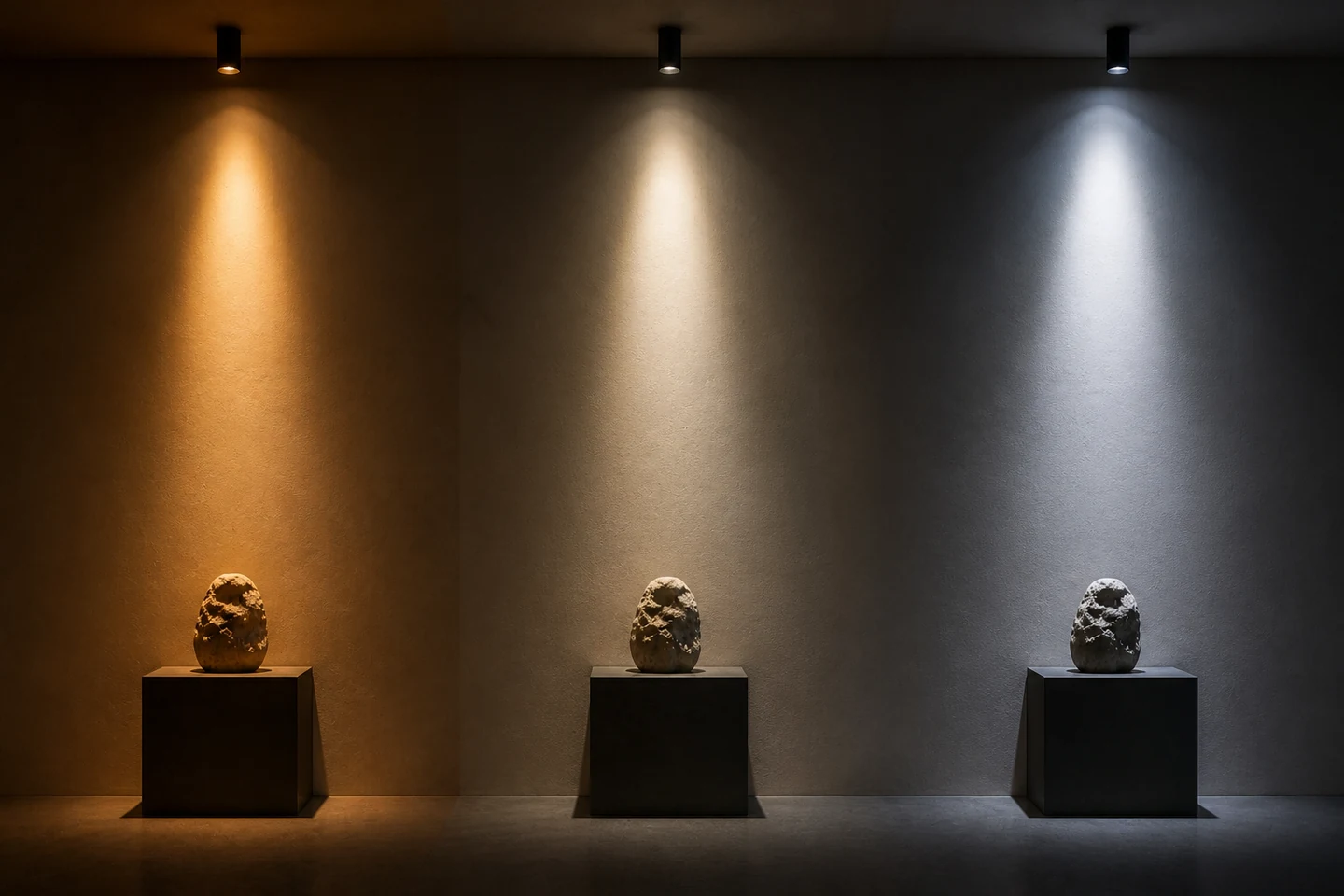
Correlated color temperature indicates whether the white appears generally warm or cool. CRI or Rf addresses color fidelity within its own metric. They are different properties: a warm lamp can have high or low fidelity, and two high-CRI lamps can differ in tint and spectrum.
If the package omits beam angle, dimmer compatibility, enclosed-fixture suitability, wet-location rating, or flicker data, find the full specification sheet. Do not assume missing information is favorable.
Rated life is a comparison, not a date
Rated hours are measured under test conditions and describe a population or performance threshold, not the exact day one lamp will fail. Heat, enclosure, switching, controls, voltage, and product construction can affect life.
Check warranty terms separately. A long rated life paired with a short warranty, difficult return process, or non-replaceable integrated source deserves a closer look.
Keep a photo of the label and receipt. It makes future matching and warranty questions much easier.
Compare brightness first, energy second, then color, distribution, compatibility, life, and warranty. The box is the beginning of the specification, not the whole specification.
Source desk
References
- U.S. Federal Trade CommissionShopping for Light Bulbs↗
- U.S. Federal Trade CommissionLighting Facts Label: Questions and Answers for Manufacturers↗
- U.S. Department of EnergyPurchasing Energy-Efficient Light Bulbs↗
Sources support the stated concepts; Glow & Gauge’s simplified planning tools are independent adaptations and not endorsed by these publishers.