
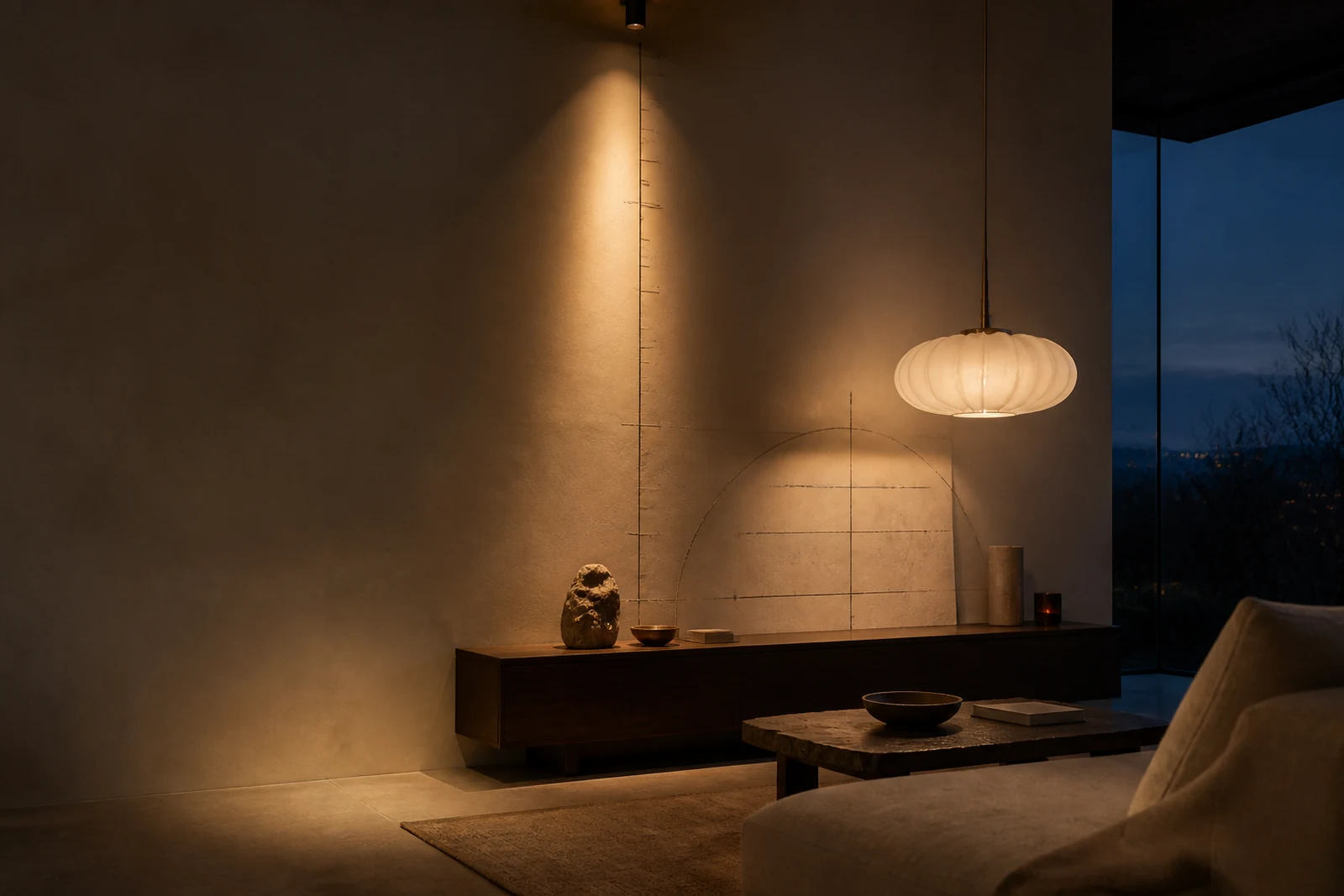
A room can contain plenty of lumens and still feel flat, glaring, or dim where work happens. The problem is often distribution. Layering assigns separate fixtures to general orientation, close visual tasks, and emphasis so one system does not carry every demand.
Ambient light establishes the field
Ambient light supports movement and a general sense of brightness. It may come from indirect light, ceiling fixtures, wall wash, or reflected table and floor lamps. It does not need to deliver the highest task illuminance to every horizontal surface.
A lower, comfortable ambient level can leave visual headroom for task and accent layers. Uniformity is useful in some rooms, but perfect uniformity can remove depth and waste light where it is not needed.
Task light closes the distance
Task light puts controlled output near reading, cooking, making, grooming, or work. Bringing the source closer can deliver useful illuminance with fewer lumens than increasing the entire room’s ceiling output.
Position matters as much as output. Place task lights to avoid casting your own shadow and shield the source from direct view. Reflective screens, stone, and glossy counters may require testing from the actual eye position.
Accent light creates hierarchy
Accent light gives the eye a destination: art, texture, shelving, plants, or architecture. Contrast—not raw brightness alone—creates emphasis. A narrow beam or grazing angle may do more than an additional ceiling grid.
Controls let the hierarchy change. Separate dimmable circuits or smart groups can support cleaning, cooking, reading, entertaining, and late-evening scenes without replacing fixtures.
Plan circuits and controls with a qualified electrician. This site addresses visual intent, not wiring or load design.
Give ambient, task, and accent light different jobs, then use controls to change their relationship rather than asking every fixture to do everything.
Source desk
References
- Illuminating Engineering SocietyRecommended Practice: Lighting for Interior and Exterior Residential Environments↗
- U.S. Department of EnergyLED Basics↗
Sources support the stated concepts; Glow & Gauge’s simplified planning tools are independent adaptations and not endorsed by these publishers.