
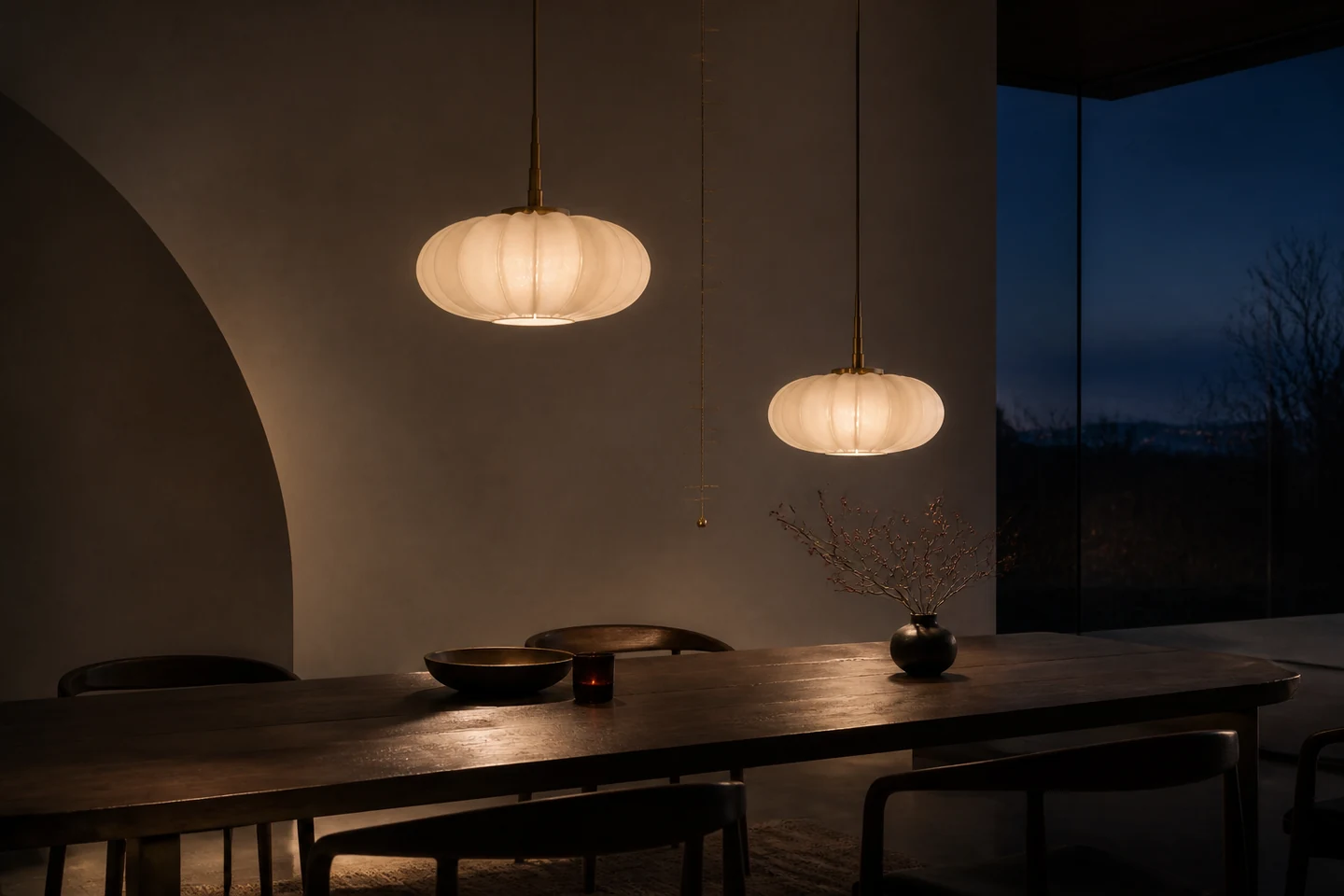
Advice about pendant height is often reduced to one measurement above a table. That is convenient, but a compact opaque shade, a wide translucent globe, and a cluster of bare lamps do not create the same view or glare. Treat the published range as a mock-up starting point.
Calculate the physical drop first
Subtract the surface height and desired clearance from the ceiling height. That gives the total distance from ceiling to the bottom of the fixture. Subtract the fixture body height to estimate the cord, cable, chain, or stem length.
Keep units consistent and measure the fixture itself rather than relying on a product title. Canopies, couplers, loops, and decorative hardware can change the installed drop. Confirm the manufacturer’s minimum and maximum suspension lengths.
Mock up the bottom edge
Tape a paper silhouette or hang a light cardboard disc at the proposed bottom height. Sit and stand at every likely viewpoint. Check conversation across a dining table, work across an island, and the view from adjoining rooms.
The brightest part of the lamp should not sit directly in a normal line of sight unless the fixture is designed for it. A diffuser, shield, or lower-output lamp can matter more than a small height adjustment.
Read groups as one composition
For two or more pendants, assess the group width, spacing, and edge clearances as one visual object. Identical mathematical spacing can look off if the table is asymmetrical, the shades vary, or the ceiling is sloped.
Photograph the mock-up from the room entrance and seated eye level. A phone image flattens the view enough to reveal alignment and scale problems that are easy to miss while standing beneath the fixture.
Never adjust a live fixture or ceiling box without following the manufacturer’s instructions and local electrical requirements.
Calculate a starting drop, mock up the fixture’s real silhouette, and approve it from seated and standing sightlines before installation.
Source desk
References
- ENERGY STARLight Fixtures↗
- Illuminating Engineering SocietyRecommended Practice: Lighting for Interior and Exterior Residential Environments↗
Sources support the stated concepts; Glow & Gauge’s simplified planning tools are independent adaptations and not endorsed by these publishers.