
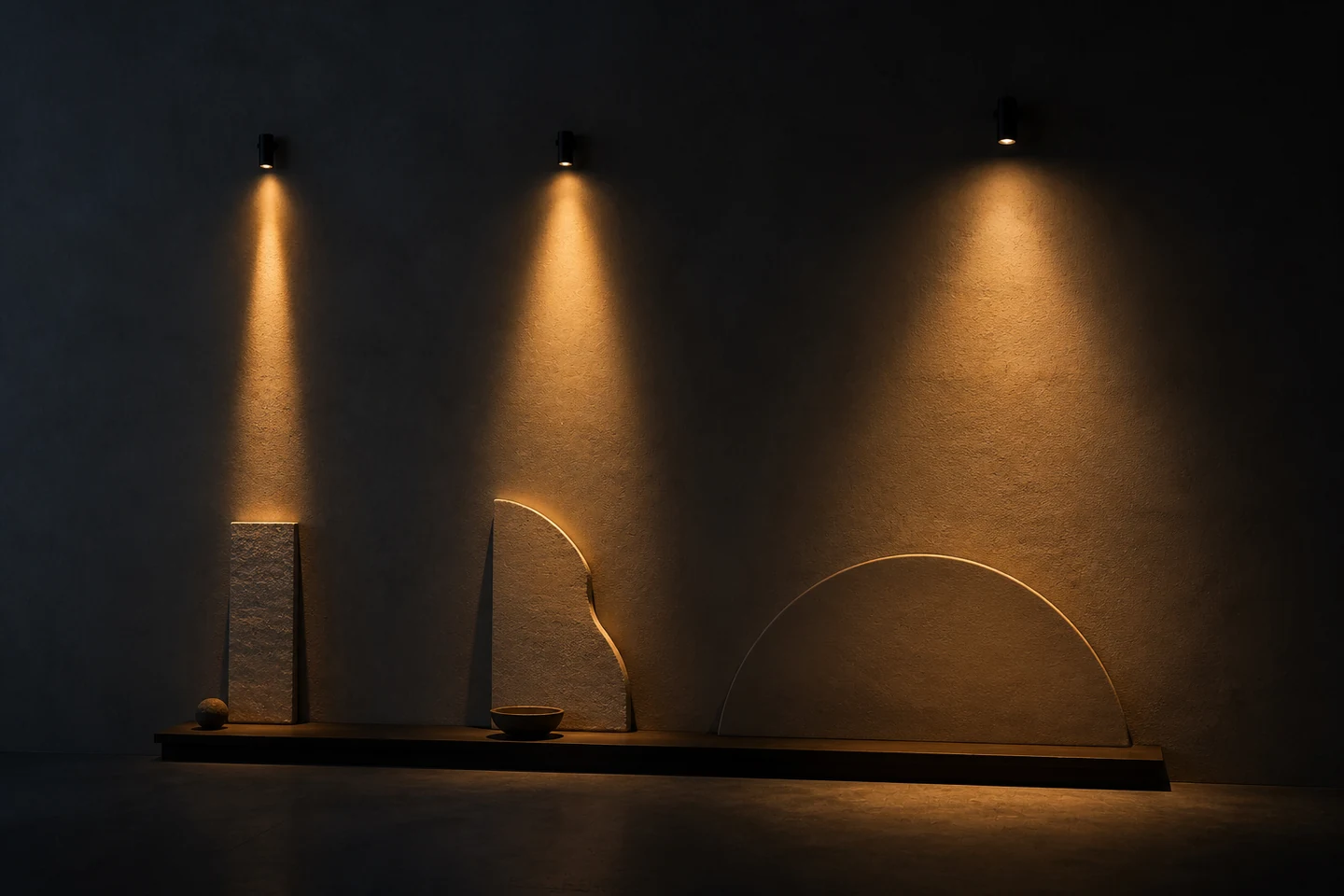
A 24-degree spotlight and a 60-degree flood are not simply dim and bright versions of the same thing. They shape light differently. A narrow beam concentrates attention; a wide beam covers more surface but spreads the output across a larger area.
The useful geometry is simple
For a symmetrical cone aimed straight at a flat surface, approximate diameter equals two times the throw distance times the tangent of half the beam angle. The distance and output diameter stay in the same unit, so eight feet in returns feet out, while two metres returns metres.
Doubling distance doubles the diameter. Increasing angle changes diameter nonlinearly because the tangent grows faster toward very wide angles. The calculator draws this relationship so you can see why a modest angle change can materially widen the pool of light.
Beam angle is not the whole light field
Manufacturers often distinguish beam angle from field angle. The beam may be defined around a central intensity threshold while the field includes dimmer spill outside it. Product conventions vary, so the same nominal angle does not guarantee identical edges or intensity.
A real photometric file shows candela distribution and helps predict illuminance. Reflectance, lens quality, aiming, shielding, wall texture, and other light sources also change what the eye sees. Our geometry is a first sketch, never a substitute for the fixture’s data.
Use the calculator to frame a question—then open the manufacturer’s IES or LDT file for the answer specific to the fixture.
Match the shape to the job
Narrow beams can isolate art, texture, or a small tabletop feature. Medium beams often suit accent pools and overlapping ceiling layouts. Wider distributions can support ambient coverage, wall washing, or broad work areas when the fixture and spacing are designed for it.
Avoid choosing by angle alone. A narrow beam with low center intensity can disappoint, while a strong wide beam can still create glare. Check lumen output, center beam candlepower or intensity plots, shielding, and the actual mounting distance together.
Beam angle describes shape. Distance turns that shape into a footprint; photometry tells you how much light is actually in it.
Source desk
References
Sources support the stated concepts; Glow & Gauge’s simplified planning tools are independent adaptations and not endorsed by these publishers.